
 The Wallet Shoppe

You’re here because you’ve heard about powerful magnets demagnetizing your cards. Is it true? Will the magnets in money clips really wipe all of your cards?
Here’s the lowdown on magnetic wallets and money clips.
Do Magnetic Wallets and Money Clips Demagnetize Credit Cards?
So you got a new wallet or money clip for your birthday…or maybe Christmas? But wait! This wallet is a little different than others you’ve used in the past…it’s held together by a magnet?
We’ve all seen them, typically in the form of a money clip with two magnets that “pop” the sides together. Let’s admit it, that “pop” is really satisfying, right?
Now don’t get us wrong… that’s great for keeping your money clip together. But that’s not why you’re here. You want to know if it’s going to be a problem down the line for your cards.
The short answer: a strong magnet right up against a magnetic stripe can wipe it. Whether yours will depends on the card, the magnet, and how close the two get. Here’s what you need to know.
Not All Cards Are Created Equal
First, some cards are much easier to wipe than others.
Cards such as hotel keys and some work badges often use a less robust kind of magnetic stripe, and they’re the ones most likely to be affected by a wallet with a magnet in it. (Not every hotel key is a stripe card these days. A lot of them are contactless, which is a different story; see below.)

Bank cards are tougher. Their stripes are rated much higher for something called “coercivity” (it’s basically how resilient they are to being demagnetized - keep reading…).
Demagnetization (Science Is Cool)
Ok, so now we turn to science. If we know what causes cards to be demagnetized, maybe we can take some steps to avoid it.
Hands down, the best place on the internet that discusses this is K&J Magnetics. As they should be: they sell some of the strongest magnets you can buy. If you want the full run-down, here’s their test. If you just want the highlights, see below.
Basically, the magnetic stripe on the back of the card stores data. That data is what tells the merchant who you are, so they know which account to charge.
Coercivity is simply a measurement of how resistant the stripe is to changes in its magnetization. That’s a mouthful. To put it simply:
- High-coercivity (HiCo) = difficult to demagnetize (most bank cards)
- Low-coercivity (LoCo) = easy to demagnetize (hotel keys)
K&J rubbed neodymium magnets across a HiCo card at measured distances, using sheets of paper as spacers, and then tried to swipe it. With their strongest test magnet, the card read fine at 0.09 inches and stopped working at 0.05 inches. A smaller disc magnet couldn’t wipe it until it was 0.02 inches away. In other words, the card survived until the magnet was very nearly touching it.
Their conservative rule of thumb is about an inch between a strong magnet and a bank card, and 5–6 inches for a LoCo card like a hotel key. Magnets stacked together, or with steel behind the card, make things worse.
How to Prevent Credit Cards from Being Demagnetized
So now that we know how it works, here are a few steps to take to keep it from happening to your cards:
Carry Cash - Magnetic money clips are generally designed to hold cash. So consider using them for that instead of carrying around all of your cards. Luckily there are enough innovative wallet makers out there with money clip/wallet designs that keep the cards away from the magnet.
Sandwich Those Cards - If you do carry cards in your magnetic money clip, keep the stripe away from the magnet and put a few bills in between. Every bit of distance helps, though a couple of notes won’t save a stripe from a really strong magnet.
Separate Those Cards - Pay attention to the cards you’re actually carrying. If you’re traveling and staying at a hotel, it’s probably not wise to carry the room key inside your magnetic money clip. Those cards are wiped and re-coded on a regular basis (on purpose - new guest, new code), so they don’t take much to scramble.
If you’d rather not think about any of this, pick a wallet with a snap or a zip, or an old-fashioned spring money clip. M-Clip’s clips hold cash with spring tension, not a magnet:
What About Chip and Contactless Cards?
The good news in all of this? Everything we’ve discussed relates to the brown or black stripe on the back of a card. More and more cards are chipped and/or contactless (the tech that lets you tap to pay).
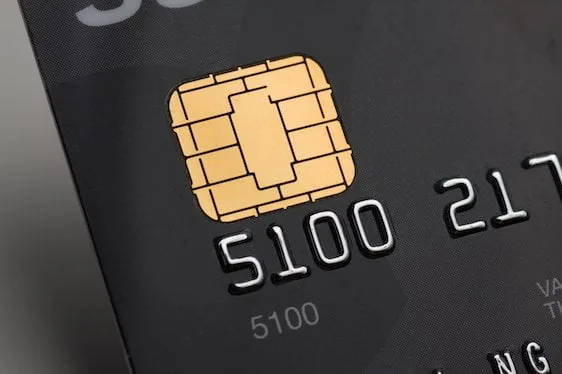
This is not an RFID chip. It’s the EMV chip you dip into a card reader.
Chips and contactless antennas are electronic, not magnetic, and K&J notes that permanent magnets don’t affect RFID chips. So a magnet that wipes the stripe leaves the chip working. Plenty of cards have all three (a chip, a contactless antenna and a stripe), so if the swipe stops working you can usually still dip or tap.
There’s one exception worth knowing about: wireless charging. Apple says not to put cards, security badges, passports or key fobs between an iPhone and a MagSafe charger, because that can damage magnetic stripes or RFID chips. If you use a MagSafe wallet, take it off before you charge.
Will a Magnetic Wallet Ruin Your Credit Cards?
The reality of the situation is this (drum roll, please)… for most bank cards, probably not. The card has to be very close to a strong magnet, and the chip doesn’t care either way.
Now we’re not going to say it’s never happened, because somewhere it will have. Hotel keys and older stripe-only cards are the ones to keep away from the clasp. But don’t let it keep you up at night, especially if your card has a chip!
If a card does stop working, call the issuer for a replacement. A failed swipe isn’t proof the wallet did it, either: worn stripes and dodgy card readers are common too. And please don’t test the theory by rubbing the magnet across a card that still works.
Before You Go…
Now that we’ve (hopefully) set your mind at ease about magnets and credit cards, there’s another question we get asked a lot: what about RFID protection? It seems like every wallet offers it these days, but what is it, and do you really need it? We’ve got you covered in our next article: What Is RFID Blocking, and Do You Really Need It?
You might also like our best AirTag wallets.
Frequently Asked Questions
What is Low Coercivity (LoCo)?
Coercivity is a measure of how resistant a magnetic stripe is to changes in its magnetization. Low coercivity means easy to demagnetize. Hotel keys are the classic example.
What is High Coercivity (HiCo)?
High coercivity means hard to demagnetize. Most bank cards use HiCo stripes, and in K&J Magnetics’ test one only stopped working when a strong magnet was within a few hundredths of an inch.
Do Magnetic Phone Cases Damage Credit Cards?
MagSafe and similar phone cases put a magnet close to any wallet that attaches to the back of the phone, so there’s a small risk to cards that store data on a magnetic stripe: older cards, transit cards, ID cards and hotel keys. The bigger risk is charging: Apple says to keep cards out from between the phone and a MagSafe charger.


