
 The Wallet Shoppe

Backpacks are great for heavier loads, but there are limits. So how much should a backpack weigh? Grown-ups, kids, commuters and hikers - we’ve got you covered!
Once upon a time, backpacks had two main uses: hiking and carrying schoolbooks. There was a sense that they weren’t quite right for the office.
Those days are long gone!
Backpacks are everywhere now, in styles to suit any setting. Hands-free convenience plus better load management - what’s not to love?
But a key question remains…
The Short Answer: 10-20% of Your Body Weight
The usual guideline is that a well-adjusted (note that!) loaded backpack shouldn’t weigh more than 10-20% of your body weight, with the lower end for day trips and children.
| Use | Published guideline | How to apply it |
|---|---|---|
| Child’s school backpack | The American Academy of Pediatrics says no more than 15% of body weight | Keep it lighter when possible, and watch for signs of discomfort |
| Day hiking | REI suggests about 10% of body weight or less | Include water and everything you carry for the route |
| Overnight backpacking | REI suggests about 20% of body weight or less | Allow for food, water and shelter; don’t ditch safety gear to hit a number |
| Adult commuting | No single percentage suits every person and commute | Carry what you need, and lighten up if it hurts |
Sources: AAP school backpack guidance and REI pack-weight advice.
So just to be really clear: someone who weighs 150 pounds would carry around 15 pounds on a day hike and up to 30 pounds on an overnight trip. Those are ceilings, not targets to fill up to!
These figures include the pack itself, so load it up and weigh it.
Pro Tip: your pack probably won’t balance well on bathroom scales, which can give a false reading. That’s easy to fix. Weigh yourself without the pack, then again with it on. The difference is the loaded pack’s weight. (A luggage scale works too.)
The More Complicated Answer
OK, so that’s it, right?
Well, no, not really. It’s a simple first pass, but it’s not everything.
Ideal Weight For a Child’s Backpack
I’ll admit it - I’d assumed kids these days wouldn’t be carrying around heavy textbooks the way I used to. After all, isn’t everything digital now?
Turns out, no.
When I first realized how heavy my daughter’s backpack had become in middle school (let alone high school!), I got very concerned. Heavy hardback textbooks, gym gear, a phone (yes, I eventually decided she was mature enough to use one sensibly) - it all added up. It was worth emptying the bag together to see where the weight was coming from.
A child who’s still growing is particularly vulnerable to heavy loads, so I’d naturally aim for the lower end of the range. If your child struggles to lift the bag, leans to carry it, or complains of pain, lighten the load (and ask the school about lockers or alternatives for heavy books). If you have any real concerns, talk to your child’s doctor.
The big thing here is that how you wear a backpack matters - a lot. Have a conversation with your child about wearing it on both shoulders with the straps properly adjusted, so the pack sits close to the back (not slung over one shoulder). That’s the single biggest thing you can do. Oh, and make sure the straps are comfortably padded too.
Ideal Weight For a Daily Commuter Backpack
Most commuter backpacks are frameless daypacks, so it makes sense to stay toward the lower end of the range here too. You’re getting more support than with a messenger-style bag, but there’s no hip belt or aluminum frame to share the load. It’s all on your shoulders.
The ideal weight for you depends on your strength, not just your body weight. But the easiest win is getting rid of the stuff that lives in there by accident: old paperwork, spare cables, that second charger. Empty the bag every so often and only put back what you need.
Ideal Weight For a Hiking Backpack
Ah, this is where the weight starts getting piled on!
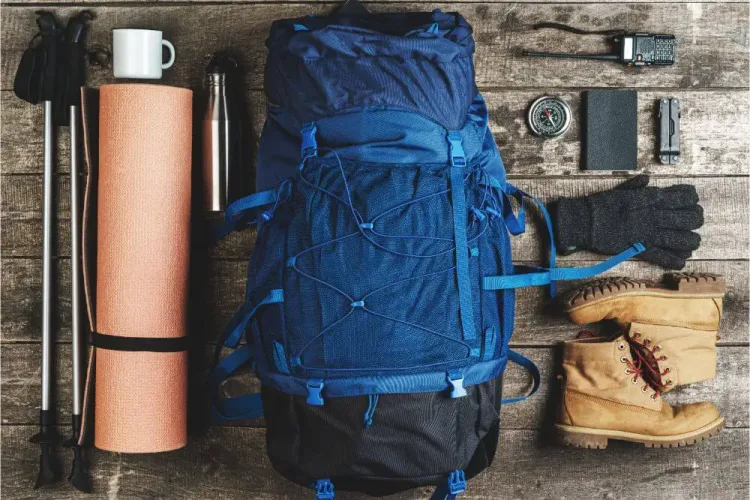
Hiking packs are usually the most heavily loaded, because you have to carry everything you need, whether it’s a day hike or a week on the trail. They’re designed for it, with an internal frame and a hip belt to move some of the weight off your shoulders, but that doesn’t mean the laws of physics don’t apply!
Our advice: resist the temptation to pack the “just in case” items. (Not the emergency gear, though. Pack light doesn’t mean leave the first aid kit behind.) The pack will only get heavier, or seem to anyway, toward the end of every day!
The good news? Modern packs and gear (from stoves to tents) are much lighter than they used to be. So as your equipment needs replacing, do your homework and look for the lightest gear that still fits well and suits your conditions.
Your body will thank you when you crest what you only thought was the last ridge… only to find your campsite seems just as far away as it did at the start of the day!
Pro Tip: before heading out on your trek, fill your backpack with everything you think you need and walk around your neighborhood for an hour. You’ll be surprised how it concentrates the mind…
Before You Go…
That’s a wrap - hopefully you’ve got a good idea of what to aim for now. But it doesn’t stop there! How you pack a hiking backpack can make a huge difference to whether you enjoy your trek or curse the day you agreed to it. Check out our next article: How To Pack a Hiking Backpack


