 The Wallet Shoppe
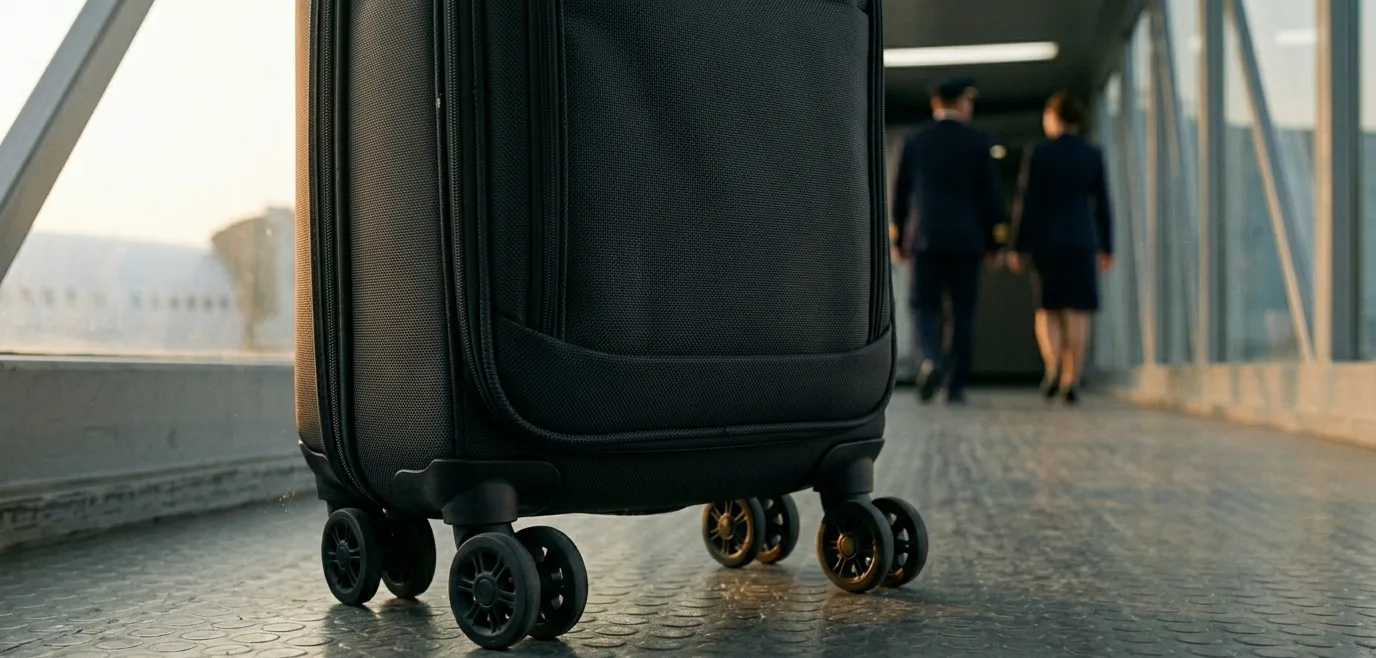
If you stand at a gate at JFK or O’Hare and watch the crews come off the jet bridge, the bag that rolls past most often isn’t a Rimowa, an Away, or a Tumi. It’s a Travelpro, and it’s been a Travelpro since the brand’s founder — a Northwest Airlines 747 pilot named Bob Plath — invented the rollaboard suitcase in 1987.
Travelpro says more than 500,000 aviation professionals carry their bags. That’s a useful number to anchor on when someone asks what carry-on to buy: “what do the people who pull this bag through a terminal six days a week pick?” beats “what costs the most?” almost every time.
The wrinkle is that Travelpro sells three completely different lines that all get called “the pilot bag,” and only one of them is the bag working aircrew actually carry on duty. The other two are very good consumer suitcases that ride the association.
Why Pilots Buy Travelpro
Three reasons, in order: the wheels survive being dragged across jet bridges, the handles don’t develop slop after a year of daily use, and the bag is sized to fit every domestic carrier’s overhead bin without an argument. None of that sounds glamorous, which is the point — aircrew don’t pick gear that looks impressive at a hotel bar. They pick gear that doesn’t need to be replaced.
The brand also runs a dedicated aviation division (aviation.travelpro.com) that sells direct to flight crews through uniform shops, MyPilotStore, and Pilot Mall. That’s where the FlightCrew 5 line lives. You won’t see it on department-store endcaps, and it’s only intermittently on Amazon.
The Three Travelpro Lines, Explained
| Line | Who It’s For | Where You Buy It | Warranty |
|---|---|---|---|
| FlightCrew 5 | Working pilots and flight attendants | Aviation channels (Pilot Mall, MyPilotStore, uniform shops) | 3-year commercial use |
| VersaPack+ | Frequent flyers who want the crew bag’s DNA | Amazon, Travelpro.com | Lifetime limited (consumer) |
| Platinum Elite | Frequent flyers who want premium fabric and a USB port | Amazon, department stores | Lifetime limited (consumer) |
| Maxlite 5 | Occasional travelers, budget pick | Amazon, big-box stores | Limited |
A common assumption is that the Platinum Elite is what working crew carry on duty. It isn’t, quite. You’ll see plenty of crew with Platinum Elite bags — but usually off-duty, on personal trips, or as an upgrade after a crew bag retired. On duty, the bag is almost always a FlightCrew 5 or the ballistic-nylon VersaPack+, because those two have wheel housings and handle systems built for the abuse a working bag takes.
If you want the closest thing to what working aircrew carry without going to a pilot supply store, buy the VersaPack+. It’s the civilian-channel version of the same construction philosophy — Travelpro retired the Crew Versapack name, but the ballistic nylon, the wheels and the handle carried straight over.
Our Top Picks
Travelpro VersaPack+ — the civilian version of the crew bag: ballistic nylon with DuraGuard, MagnaTrac spinner wheels, PowerScope handle.
Travelpro Platinum Elite 21" — softer finish, leather accents, the bag frequent flyers buy when they want the Travelpro reliability with a less utilitarian look.
Travelpro Maxlite 5 — the lightweight pick if you fly twice a year and don't need ballistic nylon.
Briggs & Riley Baseline Essential — heavier, pricier, and backed by a no-questions-asked lifetime warranty that covers airline damage.
Travelpro VersaPack+ 21” Spinner
This is the bag to buy if you want as close to the actual crew bag as the consumer channel sells. It’s built on the same wheel and handle hardware Travelpro uses for the FlightCrew line — eight magnetic-aligned MagnaTrac spinner wheels, an airline-grade PowerScope handle, and a high-density ballistic nylon shell with a DuraGuard coating that shrugs off scuffing and sheds water.
The details that give it away as a crew-DNA bag: a full-length interior lid pocket sized for paper documents and a passport, an easy-access external pocket for the things you need out before you reach the bin, and a tapered expansion that adds two inches of depth without making the bag lean. A built-in TSA lock saves you the ritual of watching someone cut a padlock off.
It’s not the best-looking bag in the lineup. Ballistic nylon with industrial hardware reads as “pilot,” not as “designer.” If you want something that looks more at home in a boutique hotel lobby, the Platinum Elite below is the same brand’s softer-looking alternative.
The honest catch: there’s no USB port or power bank pocket on this one — if in-transit charging matters to you, that’s a reason to look at the Platinum Elite instead.
Travelpro Platinum Elite 21” Expandable Spinner
This is the Travelpro line most frequent flyers actually end up buying. It’s marketed at business travelers rather than working crew — same wheel/handle DNA as the VersaPack+, but with genuine leather trim, chrome zippers, a fold-out suiter, and a slightly more refined silhouette.
You’ll see Platinum Elite bags in the priority boarding lane more than in the crew line. The pitch makes sense: same brand the pros trust, but it doesn’t look like you took it off a flight attendant. The fabric is the same high-density nylon, the handle is the same MagnaTrac system, and the tip-resistant expansion gives you two extra inches of packing depth when you need it.
The Platinum Elite weighs about 7.8 lbs empty in the 21-inch spinner configuration. That’s not the lightest bag you can buy, but it’s a fair tradeoff for the structural rigidity. Lighter bags lose their shape after a few hundred check-ins. The Platinum Elite still stands up straight after years.
Where it falls short of the VersaPack+: the leather trim and chrome will eventually show wear in a way the all-ballistic-nylon crew bag won’t. If you fly forty weeks a year, the VersaPack+ ages better. If you fly six to ten trips a year, the Platinum Elite will outlast you.
Travelpro Maxlite 5 21” Carry-On Spinner
The Maxlite is the budget Travelpro. It uses a lighter polyester shell, plastic-bodied handle stays, and a four-wheel (not eight-wheel) spinner system. Empty weight drops to around 5.4 lbs, which makes it noticeably easier to lift overhead.
This is the bag to buy if you fly a few times a year, your “carry-on” routine involves a vacation rather than a layover, and you don’t need ballistic nylon to survive a hundred cycles a year. Reviewers who own both a Maxlite and a Platinum Elite consistently report the same thing: the Maxlite’s handle develops a slight wiggle after eighteen months of regular use, while the Platinum Elite handle stays tight for years. For a once-a-quarter flyer, that wiggle isn’t a deal-breaker.
The honest catch: the four-wheel spinner is less stable when fully packed than the eight-wheel system on the VersaPack+ and Platinum Elite. It also leans more readily when you’re walking, which is why the eight-wheel system exists in the first place.
Briggs & Riley Baseline Essential 22” Spinner
If you’re going to buy something other than a Travelpro, this is the bag to buy. Briggs & Riley’s Baseline line uses self-repairing zippers, a CX expansion-compression system that lets you stuff in extra cubic inches and then compress the bag flat again, and the strongest no-questions-asked warranty in luggage — the company will repair airline damage for free, for life.
You’ll see plenty of senior airline crew with Briggs & Riley off-duty, and a few with them on-duty (mainly long-haul international, where the lifetime repair guarantee matters more than crew-bag-specific ergonomics). The reason they’re not the dominant on-duty bag: the Baseline weighs about 10 lbs empty in the 22-inch spinner. That’s two pounds heavier than the Platinum Elite, and on a long terminal walk those pounds add up.
Where it beats Travelpro: the warranty. Travelpro’s warranty doesn’t cover airline-caused damage. Briggs & Riley’s does, with no questions, for the life of the bag. If you check this carry-on (which defeats the point, but sometimes you have to), every wheel chip and torn corner is a free fix.
Where it falls short: weight, and the price tag is roughly double a Platinum Elite. The build is genuinely lifetime quality, but for most people the Travelpro line gets you most of the way there for less.
What About the FlightCrew 5?
The FlightCrew 5 is the actual on-duty bag for working pilots and flight attendants. It uses a heavier 1682-denier ballistic nylon, crash-guard wheel housings, inline-skate ball-bearing wheels instead of spinners (more rolling efficiency, less prone to wobble), and a height-adjustable handle with stops at 38”, 40”, and 42.5” — because pilots come in all heights and a fixed handle hurts your shoulder over thirty thousand miles a month.
It’s sold mainly through Pilot Mall, MyPilotStore, and uniform shops like M&H. You can sometimes find it on Amazon, but stock is intermittent and the channel doesn’t carry every configuration. The warranty is also different — three years for commercial use, which is the only luggage warranty I’ve seen that explicitly covers professional aircrew duty cycles.
If you’re a working pilot or flight attendant reading this, you already know about the FlightCrew 5. If you’re not, the VersaPack+ is the closer-to-civilian equivalent and the more honest recommendation. Buying a FlightCrew 5 for occasional travel is like buying a commercial restaurant range to make weekend pancakes.
For General Aviation Pilots: The Brightline Bags
The conversation above is about airline crew — people whose bag rides through commercial jet bridges. General aviation pilots (Cessna, Cirrus, light twins, the people who fly themselves) have a different problem: they need a bag that holds two headsets, an iPad with a yoke mount, a kneeboard, a fuel sampler, a spare battery, paper charts, and a Garmin 696 — all organized, all accessible from the left seat of a 172.
That’s the Brightline market. Brightline’s pitch is modular: you buy a core bag and clip in pockets, sleeves, and panels for whatever your mission of the day needs.
Brightline B4 Swift
The B4 Swift is the entry point — the smaller, lighter Brightline configuration. It holds one bulky headset (a Bose A20 or a Lightspeed Zulu), an iPad in a yoke mount sleeve, a kneeboard, and a stack of charts. It’s what most VFR pilots flying day trips end up carrying.
Why it works: the modular front and back panels mean you can swap in a logbook pocket, a fuel tester sleeve, or a flashlight loop without buying a new bag. Brightline sells the panels separately and they all hot-swap.
The honest catch: the modular system is genuinely good, but it costs more than a comparable monolithic bag because every panel is sold separately. Expect to spend more on accessories than on the base bag if you build it out.
Brightline B7 Flight
The B7 Flight is the larger configuration — the bag for IFR-rated pilots, instrument students, and anyone flying with two headsets, a paper chart binder, and overnight gear. The center compartment fits one upright Lightspeed 3G or two David Clark H10-13.4s on their sides, with room left for a Garmin in the same pocket.
In Pilots of America forum threads, the B7 is the bag that gets recommended most often when someone asks for a serious cross-country flight bag. The complaint that comes up: at full capacity, the B7 is noticeably heavier than competing single-compartment bags. That’s the cost of the modular system — extra panels mean extra material.
If you fly a mix of local and cross-country, start with the B4. If most of your hours are cross-country with two pilots and full gear, start with the B7.
The Editor’s Pick
The Travelpro VersaPack+ 21” Spinner is the bag I’d buy with my own money and the one I’d put in a friend’s hand who asked for a carry-on recommendation. It’s the closest civilian-channel equivalent of the actual on-duty crew bag, the ballistic nylon will outlast a Platinum Elite under heavy use, and the price sits below both the Platinum Elite and the Briggs & Riley. The aesthetic is industrial, which is either a feature or a flaw depending on your taste — but if you bought it for what aircrew know about luggage rather than for the lobby aesthetic, that’s the right tradeoff.
If you want the Travelpro reliability in a softer-looking package, the Platinum Elite is the answer and there’s nothing wrong with that decision. If you want lifetime free repairs and don’t mind the weight, the Briggs & Riley Baseline is the bag that outlasts everything else.
And if you’re flying a 172 on Saturday, none of this applies to you — get a Brightline B4 Swift, clip on the panels you need, and be done.
If you want a softer carry option for the personal-item slot under the seat, our shortlist of under-seat backpacks covers the bags that pair well with any of the rollers above. For laptop-focused travel, the messenger bags for air travel guide has the crossbody alternatives.