 The Wallet Shoppe
Ekster and Secrid both solve the same annoyance — fishing through a stack of cards to find the one you need — with a spring-loaded ejector instead of a bifold’s flip-through. The mechanisms look similar from across a room, but they’re built by companies with different priorities: Ekster is a tech-forward brand that layers tracking and app features on top of the ejector, while Secrid is a pure hardware company that’s spent two decades refining the ejector itself. That difference in focus shows up everywhere from the button feel to the warranty.
The Ekster Parliament
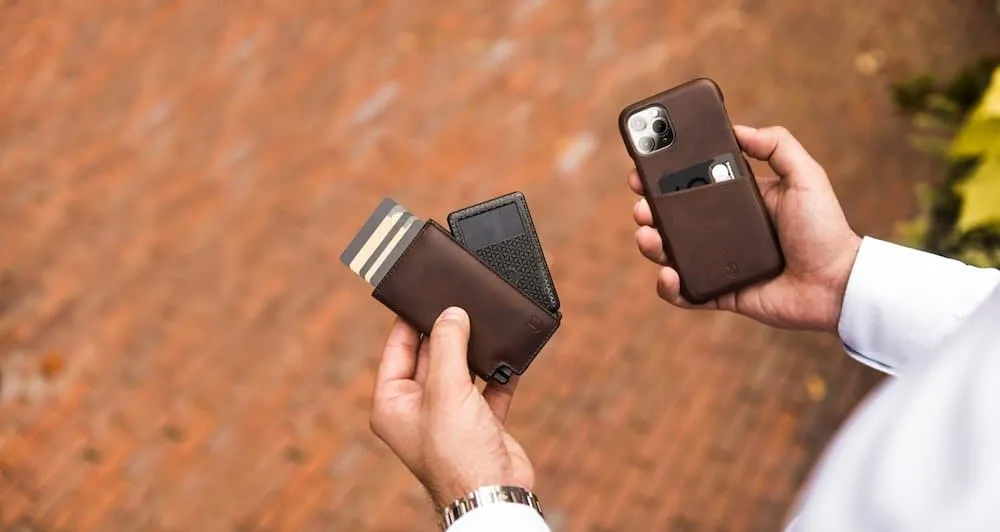
Push the button and the cards stair-step out automatically — no thumb technique to learn. The Parliament wraps that ejector in full-grain leather with a bifold layer underneath for cash, and it’s built to pair with Ekster’s solar tracker card, so a misplaced wallet pings your phone through Apple’s Find My network. Ekster also sells an all-metal Aluminum Cardholder with the same core mechanism if leather isn’t the point for you. Our full Ekster review covers the whole lineup.
The honest catch: the ejector is a mechanical part, and owners occasionally report the spring getting stiff after a couple of years of daily use. It’s not common, but it’s the tradeoff that comes with automating what Secrid does manually.
The Secrid Slimwallet
Secrid’s core idea is the Cardprotector: an aluminum shell with a spring mechanism that fans 4-6 embossed cards (or up to 12 flat ones) out in a cascade the moment you slide the lever — no button, no battery, no app. The Slimwallet wraps that core in a leather sleeve for extra card pockets and bill storage. It’s a Red Dot Design Award winner, and Secrid has been refining this exact mechanism since 2010. Our full Secrid review covers the whole line, including the pure-aluminum Cardprotector on its own.
The honest catch: no tracking, no app, no smart features of any kind — Secrid’s whole pitch is mechanical simplicity, which is a plus for reliability but a flat no for anyone who wants their wallet findable by phone.
Mechanism: Button vs. Lever
Both are spring ejectors, but they trigger differently. Ekster’s Parliament uses a push-button that automates the whole motion — you press, cards appear. Secrid’s lever requires a deliberate slide, which is marginally more manual but also a mechanically simpler action with less that can misalign over time. Secrid has a longer track record on this exact mechanism (since 2010, with a design award to show for it); Ekster’s is newer but functionally similar in daily use.
Capacity & Cash
The Ekster Parliament’s bifold leather layer gives it a real edge for cash and overflow cards — 3-7 additional slots beyond the ejector core itself. Secrid’s Cardprotector alone has essentially no cash capacity; you need the Slimwallet’s leather sleeve (which this comparison uses) just to carry bills at all, and even then it’s less generous than Ekster’s bifold layer. If you routinely carry cash alongside cards, Ekster’s design assumes that from the start.
Smart Features & Tracking
This category belongs entirely to Ekster. The solar tracker card slots into a spare card slot and pings your phone via Find My if your wallet goes missing — Secrid has no equivalent and isn’t trying to build one. If a trackable wallet matters to you, that alone settles the comparison; see our best wallet trackers roundup for how the category compares beyond just these two brands.
Reliability & Warranty
Secrid’s simpler, button-free lever mechanism has fewer failure points and a longer real-world track record. Ekster’s button-ejector is convenient but adds a component (the button and its linkage) that Secrid’s design skips entirely. Both brands back their wallets, but Secrid’s mechanism has less to eventually go wrong.
FAQ
Which ejector mechanism is more reliable long-term?
Secrid’s, on balance — it’s a simpler lever action with a track record going back to 2010 and a Red Dot Design Award behind it. Ekster’s button-ejector is newer and adds a component Secrid’s design doesn’t have.
Which one is better for someone who carries cash regularly?
Ekster’s Parliament, thanks to its bifold leather layer. Secrid’s Cardprotector has minimal cash capacity even in the leather-wrapped Slimwallet version used here.
Does Secrid make a version with tracking?
No — Secrid has no tracker-card ecosystem or app. If tracking matters to you, Ekster is the only one of these two brands that offers it.
If style matters as much as mechanism, our Bellroy vs. Ekster comparison covers the leather-traditionalist alternative to Ekster’s smart-wallet approach, and Ridge vs. Secrid covers how Secrid’s ejector stacks up against Ridge’s elastic-band design.